
MANUFACTURED CAPITAL: AT A GLANCE
Operating a Renewable Portfolio.
Following the divestment of our natural gas facilities to Prime Infra, every megawatt we operate and every kilowatt-hour we generated in 2025 comes from geothermal, hydro, wind, or solar.
New Generation and Storage Capacity.
Three geothermal plants and three battery storage systems reached commercial operations in 2025, adding 88.6MW of new generation capacity and 40MW/40 MWh of storage to the grid.
Hydro’s Strongest Year.
La Niña-driven inflows pushed hydroelectric generation to 1,074.8GWh—more than double 2024 output—while Pantabangan was fully restored to its rated 120MW capacity.
Resilience Under Pressure.
Back-to-back typhoons, equipment failures at Leyte, and a fire at Burgos Wind tested operations across all platforms; recovery plans are in place for every affected asset.
Ancillary Services Entry.
Mt. Apo geothermal units DCS upgrades enabling future Ancillary Service opening a potential higher-value commercial channel for existing assets.
Manufactured Capital as the Infrastructure of Energy Transition
At First Gen, manufactured capital is composed of the power plants, systems, and infrastructure through which the Company generates and delivers energy. In 2025, the scope of this capital was reshaped by a significant portfolio decision: the divestment of First Gen’s natural gas power plants—Santa Rita, San Lorenzo, San Gabriel, and Avion—to Prime Infra.
This was not a divestment of obligation, but of direction. The natural gas plants were transferred in strong operational condition, supported by established environmental, safety, and governance programs built over years of disciplined management. The condition of those assets at transfer reflects the operational standards and environmental accountability that First Gen applies across its entire portfolio.
What remains is a fleet anchored entirely in renewable energy—geothermal, hydro, wind, and solar. We are driven to protect this base of renewable assets as our foundation for the energy transition. The country’s energy demand still requires the proper mix between baseload and variable renewable for energy security, and our current portfolio ensures that. As we continue to scale our renewable energy capacity in alignment with our strategy, we are committed to providing top quality assets and their efficient operations.
This section reports on the performance, maintenance, development, and decarbonization outcomes of the portfolio.
Management Approach to Manufactured Capital
First Gen manages its manufactured capital with three priorities: sustaining the reliability and performance of existing assets, expanding renewable capacity, and maintaining operational resilience against climate and equipment risks.
These priorities are implemented through the ISO-certified integrated management systems (IMS) of FG Hydro and EDC geothermal subsidiaries—supported by structured maintenance planning, real-time monitoring, capital allocation processes, and safe work execution to ensure delivery of reliable power, financial return, and long-term asset integrity.
Material topics tied to manufactured capital—energy transition, physical climate risk, asset reliability, and regulatory compliance—are addressed through operating procedures, maintenance schedules, and continuous improvement programs across all facilities.
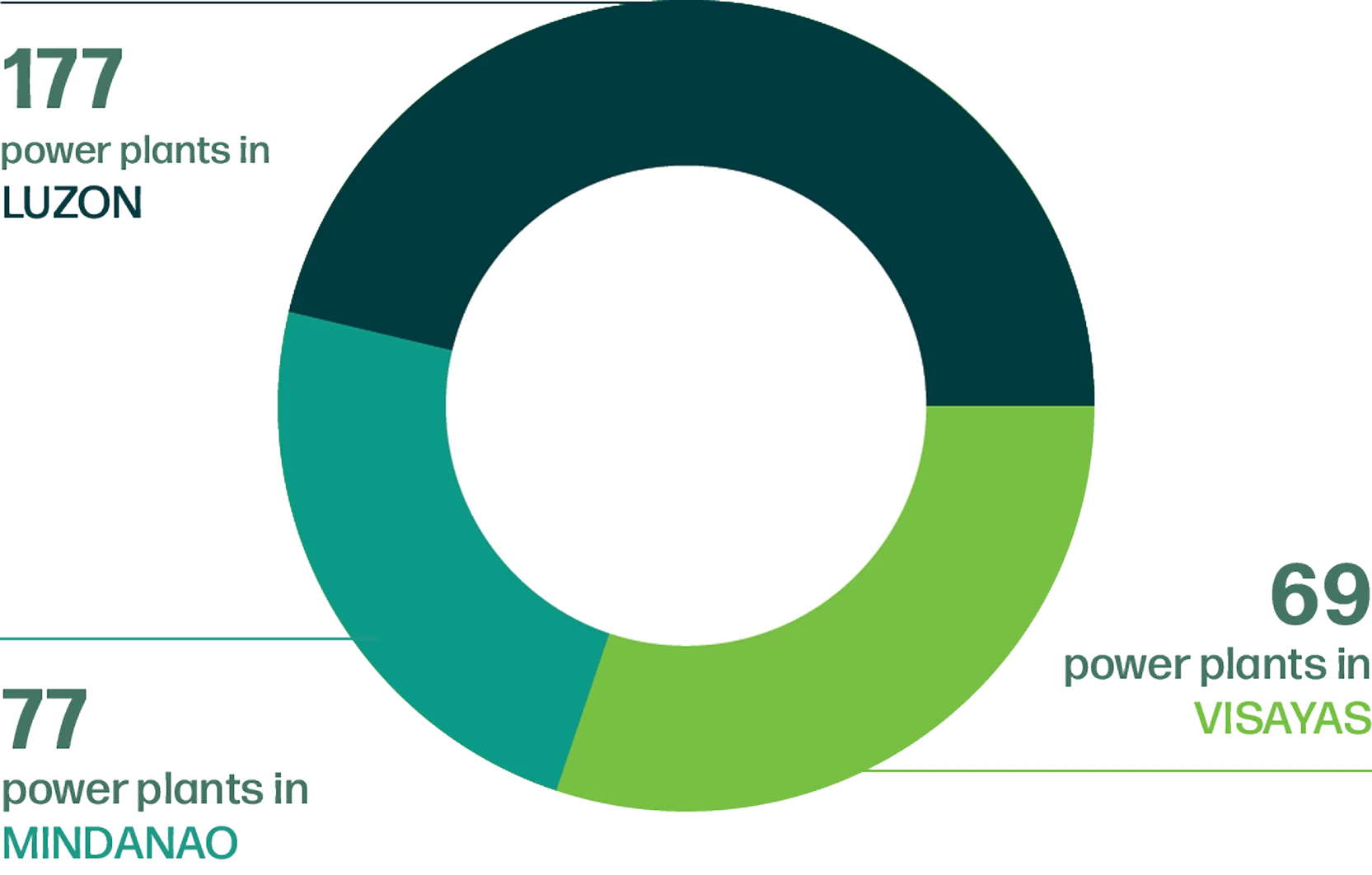
TOTAL POWER PLANTS IN THE PHILIPPINES BY REGION, 2025
Number of power plants in Luzon, Visayas, and Mindanao, based on Department of Energy List of Existing Power Plants (Grid-Connected) as of 31 December 2025
Power Projects
As of year-end 2025, First Gen operates 31 power projects and installations across the Philippines, all renewable, spanning geothermal, hydro, wind, and solar.
Total installed renewable capacity: 1,764.2MW
- Geothermal: 1,302.8MW across 16 projects
- Hydro: 299.4MW across four projects
- Wind: 150.0MW: one project
- Solar: 12.0MW across 10 projects
Geothermal and hydro assets—representing 91 percent of installed capacity—provide firm, dispatchable power that supports grid stability and contractual supply obligations year-round. Wind and solar contribute to portfolio diversification and clean energy supply across the Luzon grid.
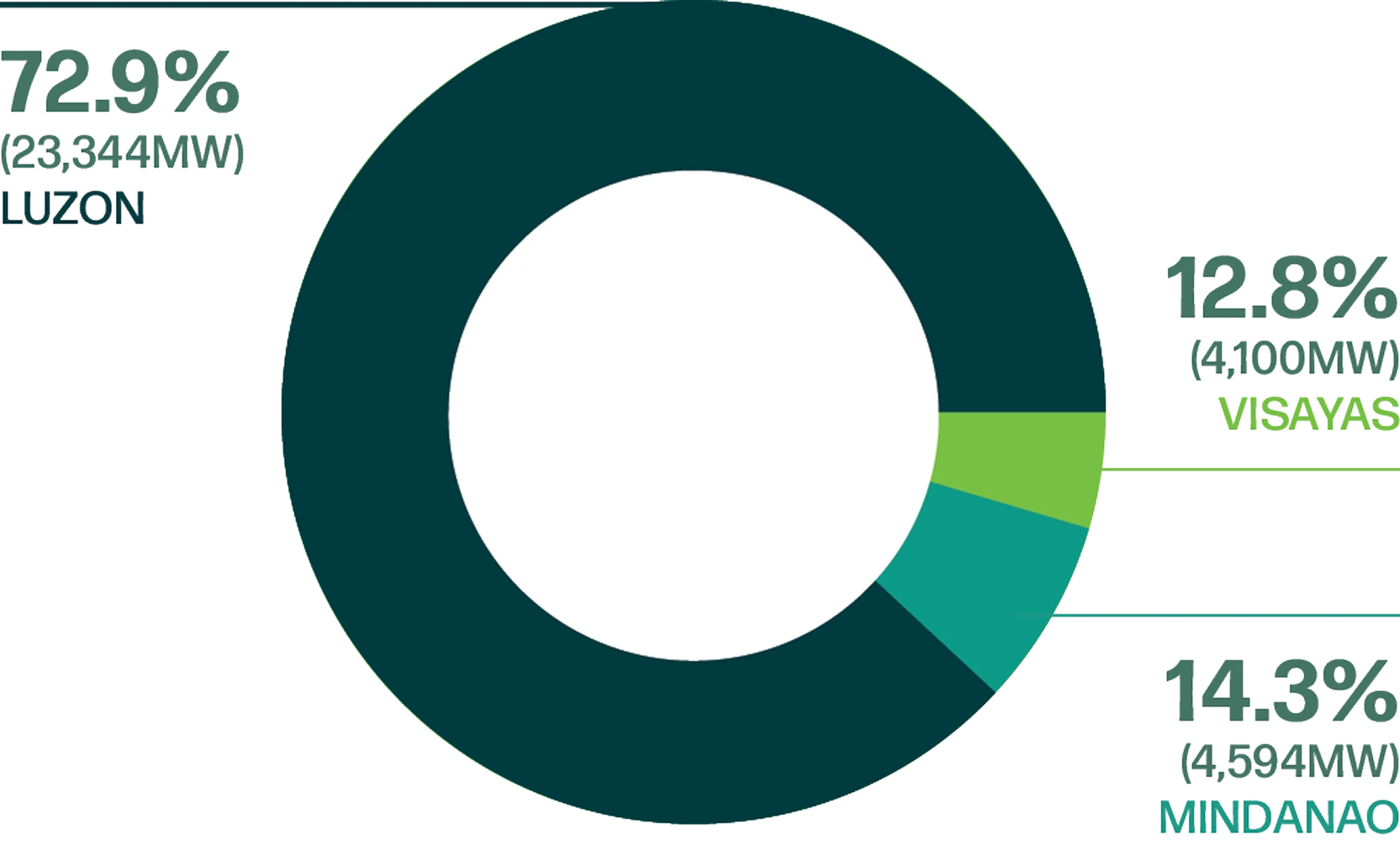
TOTAL INSTALLED POWER CAPACITY IN THE PHILIPPINES BY REGION, 2025
Percentage share of total installed power capacity (in MW) located in Luzon, Visayas, and Mindanao, based on Department of Energy List of Existing Power Plants (Grid-Connected) as of 31 December 2025
Operational Performance and Reliability
In 2025, our renewable fleet delivered 8,319.9GWh of clean energy across geothermal, hydro, wind, and solar platforms—a year marked by strong hydro performance, new capacity additions, and disciplined responses to weather and equipment challenges across the portfolio.
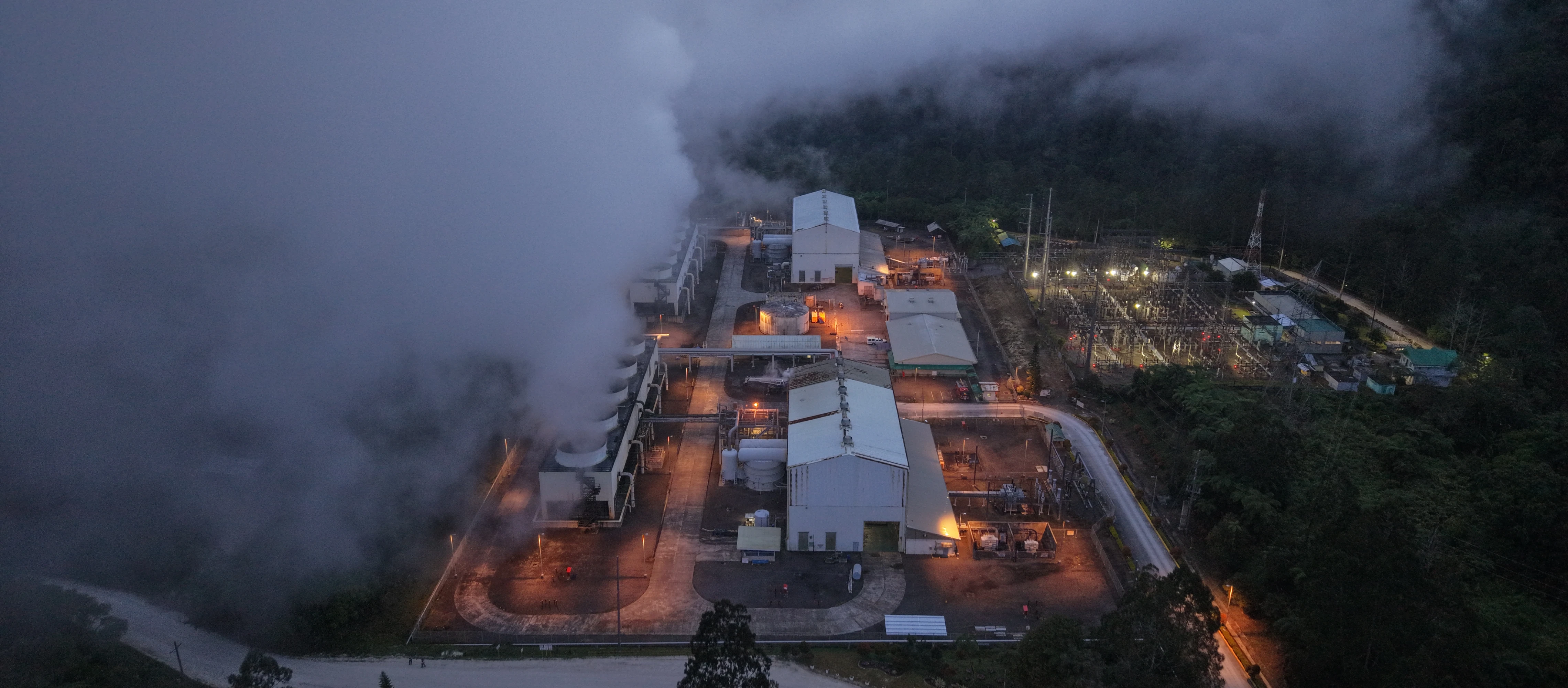
Geothermal
First Gen’s geothermal portfolio of steamfield operations and power plant assets generated 6,956.7GWh in 2025 across six facilities: Unified Leyte, Bac-Man, Tongonan, Palinpinon, Nasulo, and Mindanao. Portfolio-level availability was 88.8 percent and reliability was 90.6 percent.
GEOTHERMAL OPERATIONAL INDICATORS, 2023–2025
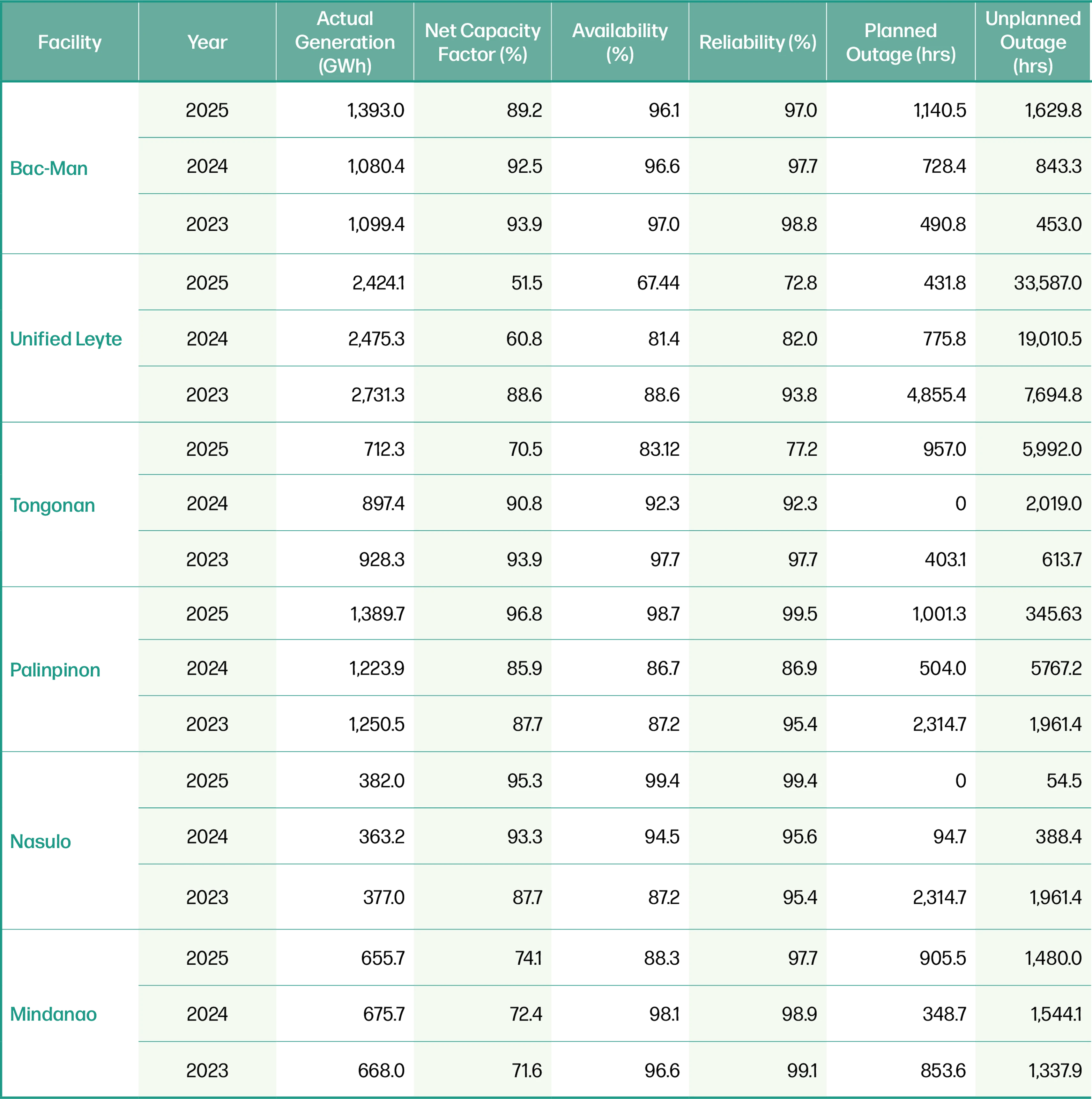
- Unified Leyte recorded 2,424.1GWh in 2025, with a generation deficit of 556GWh against the target. Availability fell to 67.4 percent, driven by turbine outages at Malitbog and Tongonan, a safety-related total shutdown of Upper Mahiao’s Air-Cooled Condenser Units, well collapses from cooling inflows and mineral scaling, and elevated total suspended solids in steam. In response, the team implemented accelerated workover approvals, steam optimization through Steam Line Injectors, and installation of Kelburn Solids Separators to allow safe operation of high-TSS wells.
- Bac-Man delivered 1,393GWh at 96.1-percent availability and 97-percent reliability. Pre-emptive unit shutdowns and deratings ahead of Typhoons Opong and Uwan resulted in an estimated 7GWh reduction in output—a precautionary measure to protect equipment and personnel.
- Negros (Palinpinon and Nasulo) exceeded its generation target, closing the year at 1,771.7GWh against a target of 1,644.6GWh. Nasulo achieved 99.4-percent availability and 99.4-percent reliability. Palinpinon Unit Sog-1, which had operated below its 20MW rated load due to low condenser vacuum, was restored to full output following its September 2025 Preventive Maintenance Shutdown. Multiple units at Negros registered as Ancillary Service providers in Q4 2025, with Pal-1 Units 1, 2, and 3 completing registration on December 23, 2025.
- Mindanao (Mt. Apo) generated 655.7GWh, exceeding its 650GWh target. M2PP experienced a 10-day deration from March 13 to 23 due to Hotwell Pump unavailability, resulting in an estimated 6.2GWh generation loss. The plant returned to full capacity following emergency repairs, including HP steam strainer installation and seal water line repairs. M1PP’s turbine control system was upgraded to a Distributed Control System during its 2025 Preventive Maintenance Shutdown (PMS), enabling future Ancillary Service Procurement Agreement certification.
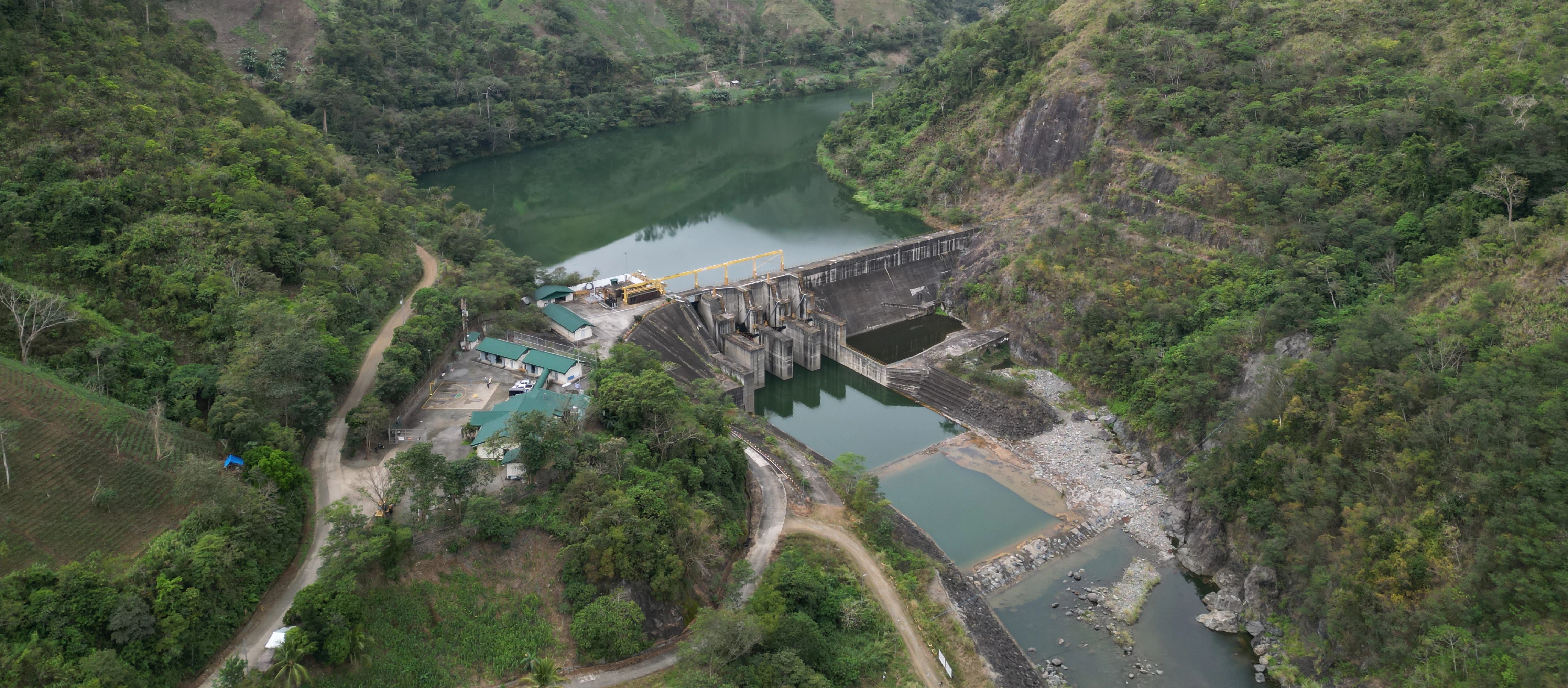
Hydroelectric
The hydro portfolio generated 1,074.8GWh in 2025 across four facilities: Pantabangan, Masiway, Casecnan, and Agusan—more than double the combined 2024 output, driven by higher water inflows under La Niña conditions.
HYDRO OPERATIONAL INDICATORS, 2023–2025
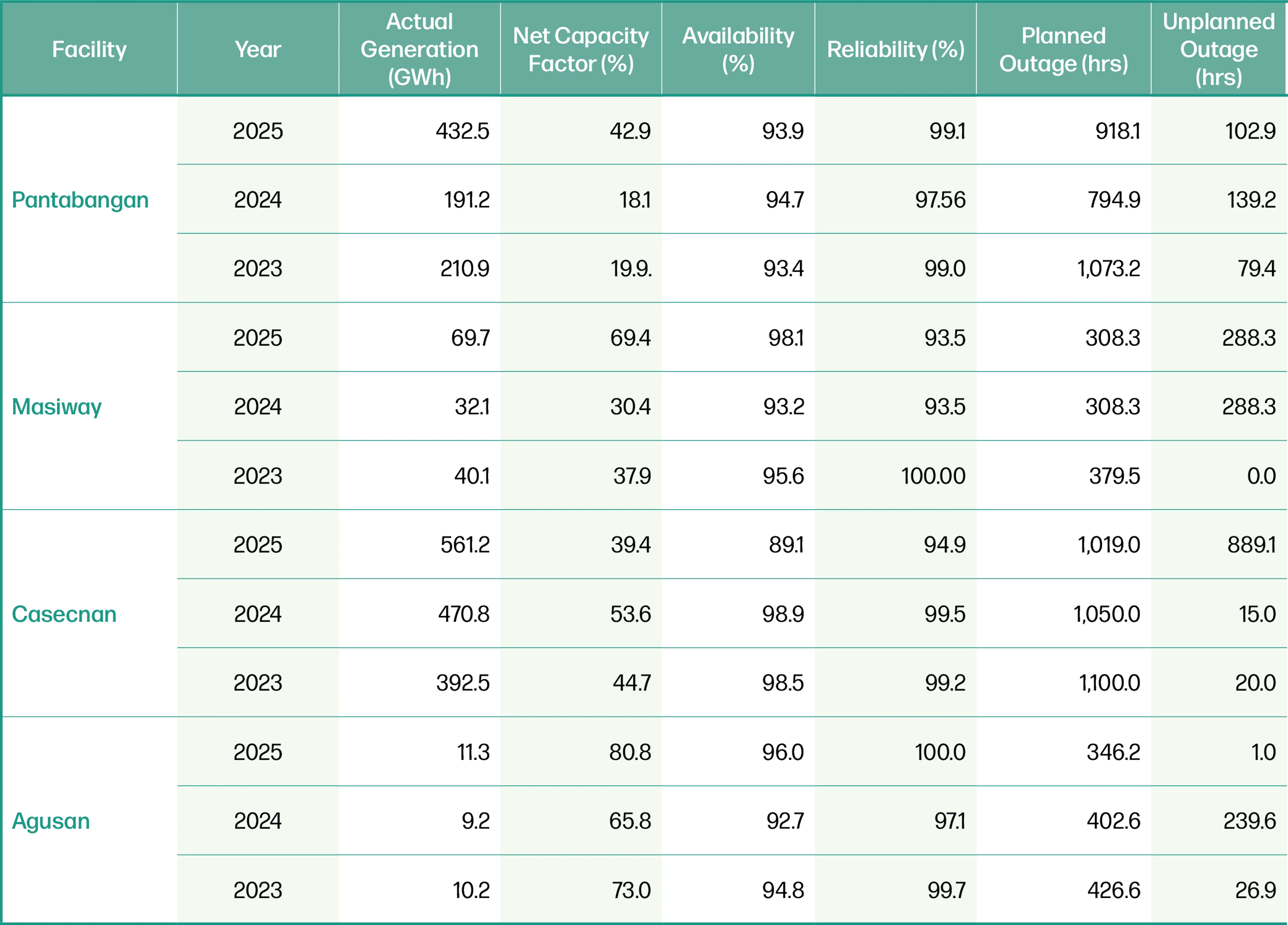
- Pantabangan-Masiway generated 432.5GWh and 69.7GWh respectively, supported by a 43.6 percent increase in reservoir inflow. The complex achieved an Availability Factor of 94.2 percent against a 94.2 percent target, and a Reliability Factor of 99.2 percent against a 99.2 percent target. Both plants were able to secure a perpectual Certificate of Compliance (COC) from the Energy Regulatory Commission (ERC) last November, 2025.
- Casecnan delivered 561.2GWh—its first full 12-month reporting period following the February 2024 asset turnover from Power Sector Assets and Liabilities Management (PSALM). The facility received a Provisional Authority to Operate from the Energy Regulatory Commission in 2025.
- Agusan recorded 11.3GWh, a 22.6 percent improvement over 2024, achieving a Net Capacity Factor of 80.8 percent against a 73.6 percent target. Following the expiration of its 20-year Power Supply Agreement (PSA) in March 2025, the plant participated in the Wholesale Electricity Spot Market (WESM) before securing a new two-year PSA effective May 26, 2025. Estimated gross revenue for 2025 was PHP58.8 million, with net income of PHP7.0 million.
Wind and Solar
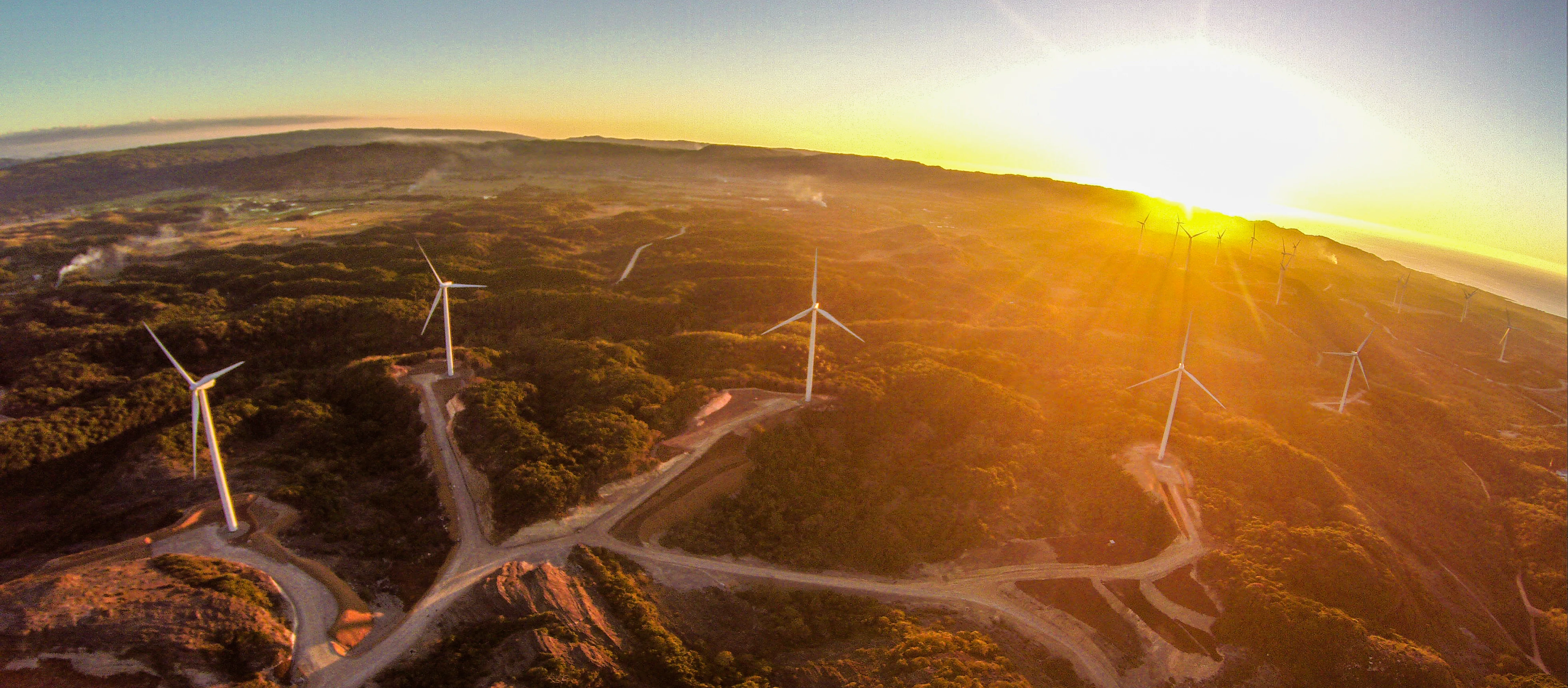
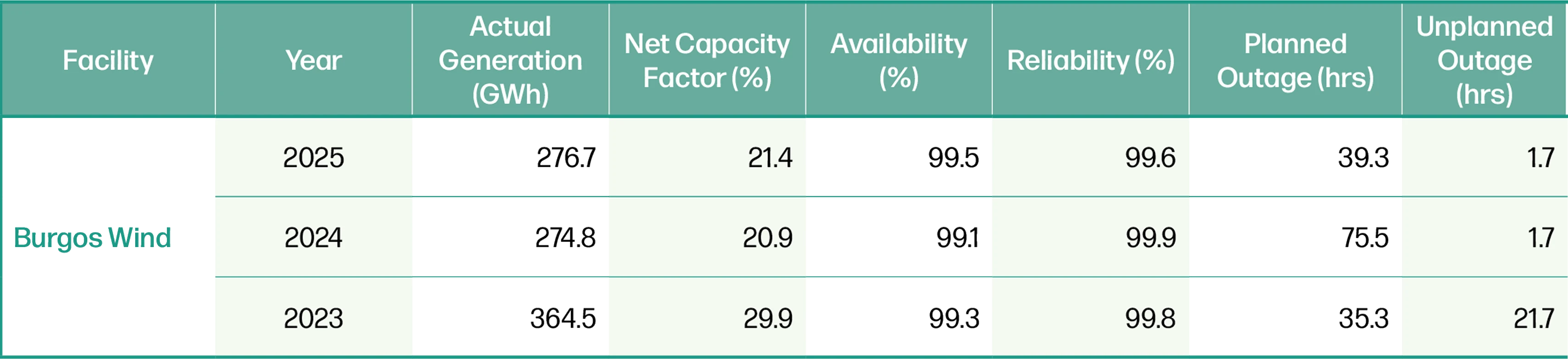
Burgos Wind generated 276.7GWh in 2025, with fleet availability of 99.5 percent, and reliability of 99.6 percent.
WIND OPERATIONAL INDICATORS, 2023–2025
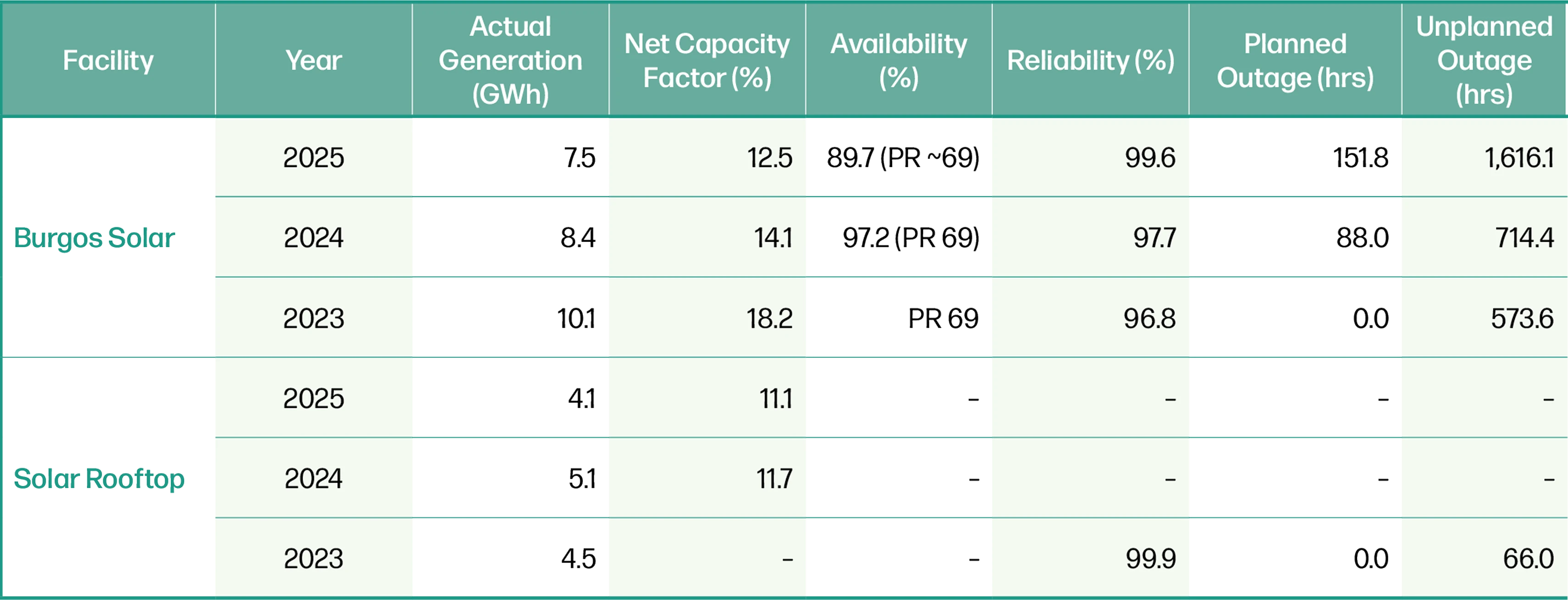
SOLAR OPERATIONAL INDICATORS, 2023–2025
Carryover blade damage from Typhoon Marce required repairs across five Wind Turbine Generators (WTGs) through April 2025. A fire at WTG C37 in early 2025, confirmed by Vestas as beyond repair, necessitated the decommissioning of the unit. As a precaution, four adjacent WTGs were taken offline for integrity checks and returned to service by February. Ring Main Unit faults in Sections 1 and 3, caused by Typhoon Nando in September and Super Typhoon Uwan in November, resulted in 15 WTGs remaining offline as of year-end. Full WTG fleet restoration is targeted for mid-2026.
Burgos Solar generated 7.5GWh, with 1,616.1 hours of unplanned outage recorded in 2025. Solar Rooftop contributed 4.1GWh.
Strengthening Operations and Future-Proofing
Across all platforms, 2025 maintenance and upgrade activities focused on restoring asset integrity, closing performance gaps, and building the technical foundation for future capacity growth.
GEOTHERMAL
At Negros, coordination between operations and maintenance teams enabled strategic deferral and compression of planned maintenance windows, maximizing generation availability across the site. Real-time equipment monitoring allowed prompt response to emerging concerns. The entry of Sog-1, Sog-2, Okoy-5, and Pal-1 Units 1, 2, and 3 into the Ancillary Services market in Q4 2025 represents a shift to higher-value grid participation. Ancillary Service pricing can reach up to 12 times the energy market rate per interval.
At Mt. Apo, the M1PP Turbine Control System upgrade to a Distributed Control System, completed during the 2025 PMS, is a prerequisite for Ancillary Service Procurement Agreement (ASPA) certification and future Ancillary Service participation. At M2PP, installation of an HP steam strainer and seal water line repairs restored baseload efficiency following the March deration.
Across all geothermal sites, our continuous monitoring of steam and brine ensure we meet generation targets. These have informed us to implement interventions to manage the resource and augment steam supply.
Internal process enhancements improved readiness to execute drilling and workover projects to secure and sustain DOP targets. Various innovations in operations range from cost optimizations to AI technologies to elevate capabilities, boost workplace productivity, and optimize asset performance.
HYDROELECTRIC
At Pantabangan-Masiway, nine recorded incidents in the Isolated Phase Bus (IPB) components had forced the plant to operate at a derated capacity since late 2024. The IPB-to-Bus Bar replacement—completed during the October 2025 APM—resolved this, restoring the plant to its full 120MW rated capacity. Separately, the Pantabangan Hydroelectric Power Plant (PHEPP) Unit 1 Control System Upgrade (Phase 1) addressed Programmable Logic Controller (PLC) components that had been obsolete since 2018 and were causing recurring electronic module failures. Unit 2 is scheduled for upgrade in 2026.
At Casecnan, the Unit 1 Main Inlet Valve Service Seal Replacement eliminated water leaks from deteriorated seals, restoring waterways system reliability. The 200 MVA to 150 MVA Power Transformer Replacement ensured continued power to station service transformers.
At Agusan, a period of low water inflow was used to complete targeted repair and maintenance work, contributing to reduced unplanned downtime. LED luminaire adoption reached 85 percent by year-end, and water consumption was reduced by 13.2 percent through line improvements and leak repairs.
Internal process enhancements improved readiness to execute drilling and workover projects to secure and sustain DOP targets. Various innovations in operations range from cost optimizations to AI technologies to elevate capabilities, boost workplace productivity, and optimize asset performance.
WIND
At Burgos Wind, operational protocols in 2025 required all blade and electrical repair work to be conducted within low-wind windows to protect personnel. Blade access platforms were maintained in continuous readiness. A firm restoration schedule for the remaining 15 offline WTGs is in place, targeting full fleet recovery by mid-2026.
Business Continuity Management System
Business Continuity Management System (BCMS) orientations and desktop simulations were conducted across EDC’s geothermal facilities in 2025, testing crisis management capabilities against defined emergency scenarios. The Company’s Crisis Management Plan was reviewed and updated. Emergency response drills were conducted across all facilities. At Agusan, emergency guidelines and response plans were updated for water elevation scenarios.
Project Developments and Milestone Updates
NEW GEOTHERMAL CAPACITY
Three geothermal expansion projects achieved commercial operations in 2025, adding 88.6MW to First Gen’s renewable portfolio.
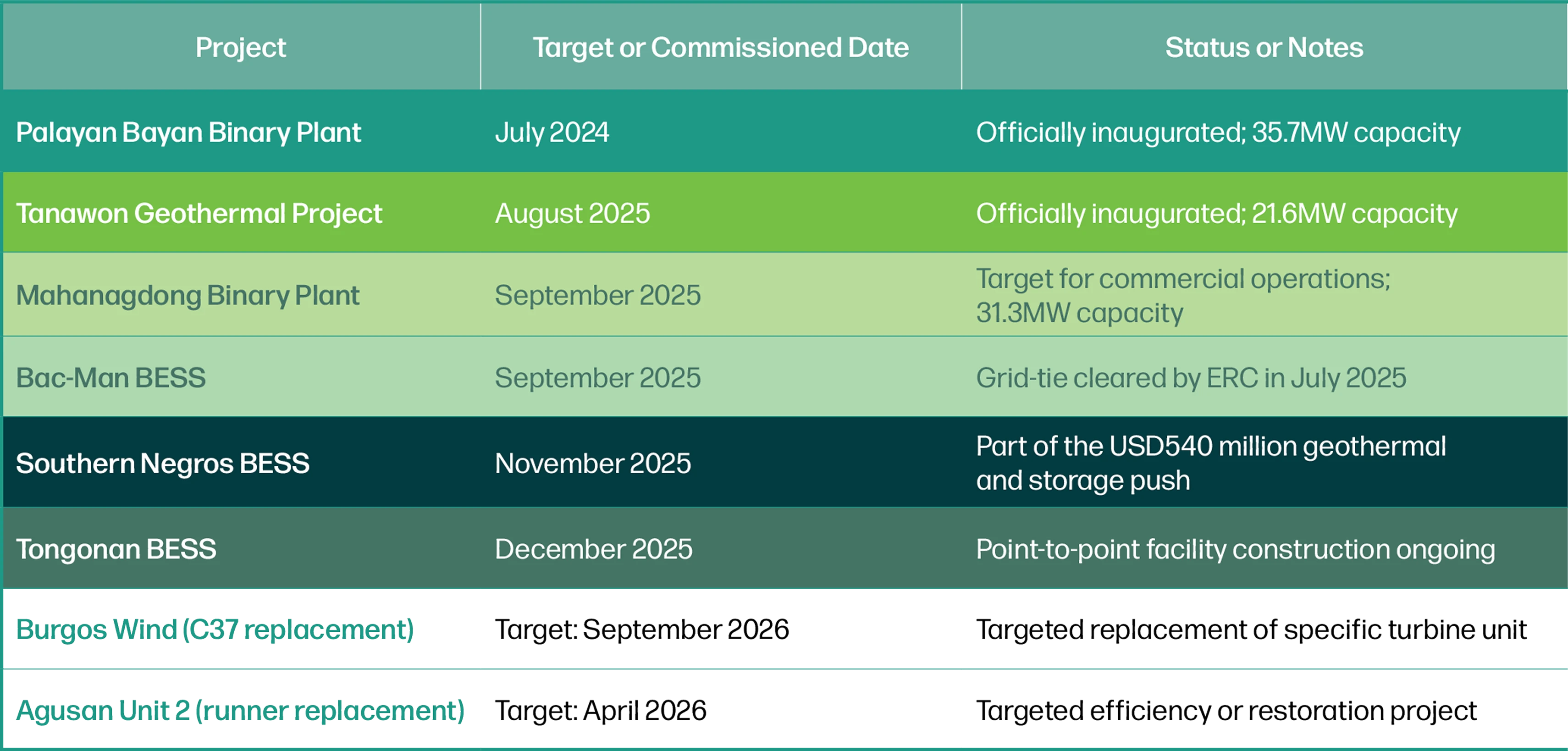
- Palayan Bayan Binary Plant (35.7MW). Secured Provisional Authority to Operate and commenced commercial operations in March 2025. Currently supplying electricity under RCOA and GEOP frameworks
- Tanawon Geothermal Project (21.6MW). Inaugurated August 1, 2025; reached commercial operations August 18, 2025
- Mahanagdong Binary Plant (31.3MW). Secured Provisional Authority to Operate (PAO) and achieved commercial operations November 2025
- Drilling and Well Intervention Program (DOP). Drilled 12 wells across the four operating fields and one exploration well; completed 19 well interventions
BATTERY ENERGY STORAGE SYSTEMS
Three BESS projects were commissioned by EDC in 2025, adding 40MW/40MWh of storage capacity across the geothermal portfolio.
- Bac-Man Energy Storage System (20MW/20MWh). PAO secured September 2025
- Southern Negros Energy Storage System (10MW/10MWh). PAO secured November 2025
- Tongonan Energy Storage System (10MW/10MWh). PAO secured December 2025
PI ENERGY
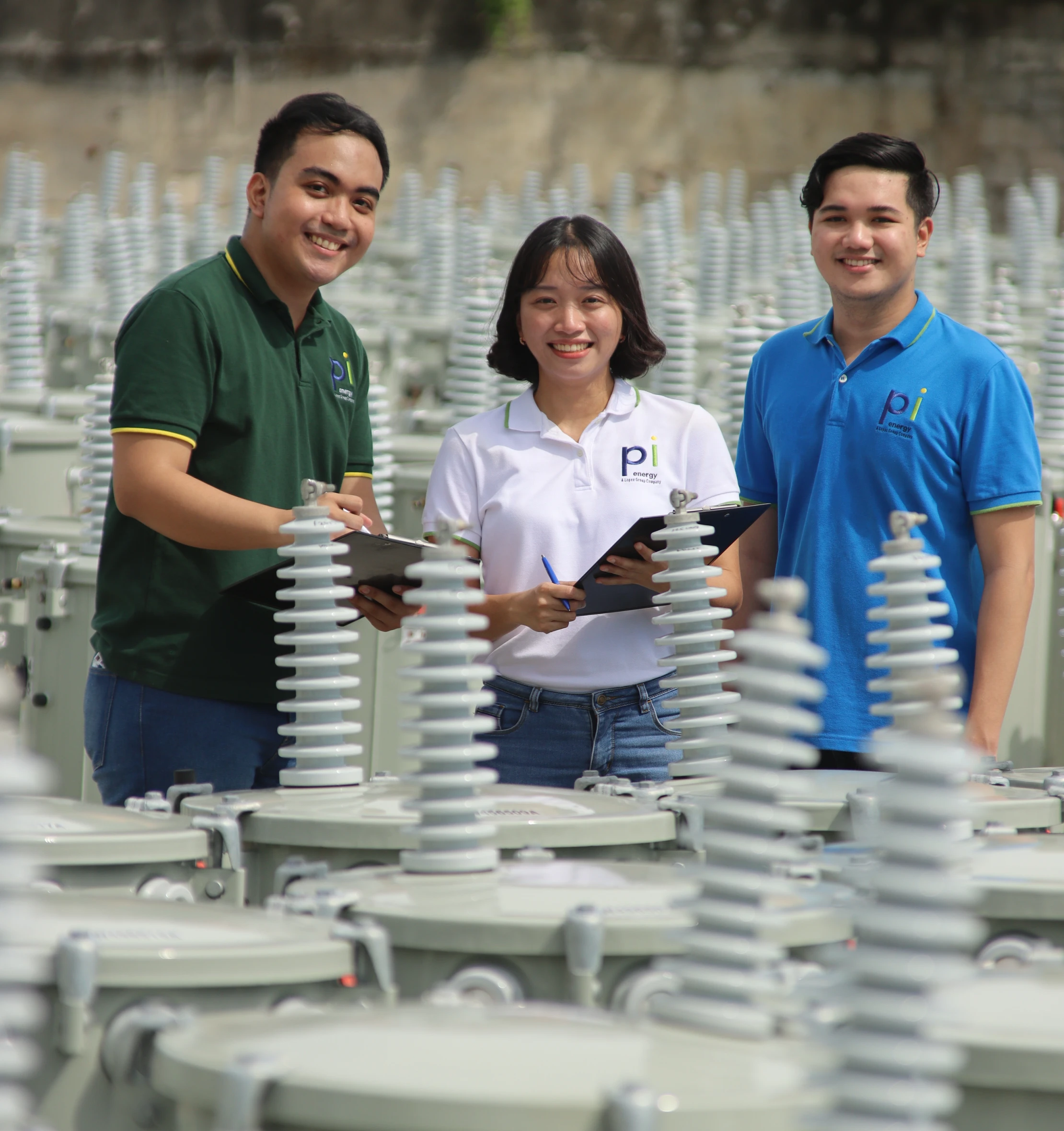
Pi Energy supported First Gen’s clean energy mission by installing 25.4MWp of solar rooftop systems across 26 sites, commissioning 89 REMS metering points, supplying and energizing multiple transformers with a total capacity of 17.25 MVA, and completing energy audits for major industrial and commercial customers, helping advance their decarbonization and energy efficiency goals.
- Solar Rooftop Installations. Energized 25.4MWp across 26 sites, including major installations for Waltermart, Goldilocks, Grand Union, and other commercial facilities
- Remote Energy Monitoring Systems (REMS). Commissioned 89 metering points and launched REMS Analytics’ 12 Data Products, enabling real-time monitoring, power quality analysis, and deeper insights into customer energy consumption
- Energy Audits. Completed audits for key customers including Energy Development Corporation (all plants), First Gen Clean Energy Complex, San Miguel Foods manufacturing facilities, Globe Telecom cellular sites, and Robinsons Land office buildings, helping optimize energy efficiency and operational performance
- Power Solutions and Transformers. In partnership with First Philec, manufactured and delivered pad-mounted and distribution transformers for customers including TV5 Reliance, De La Salle Medical and Health Sciences Institute, and Optodev, ensuring reliable and efficient power delivery
- Energy Programs and Certifications. Increased renewal energy adoption by successfully rolling out the Retail Aggregation Program through the participation of 21 subsidiaries of the First Philippine Holdings Group. Pi Energy also affirmed its expertise in delivering energy solutions by renewing its ESCO certification with the Department of Energy
- Electricity Access in Industrial Parks. Energized Hi-P Technology Philippines’ newest facility in FPIP. Pi Energy connected the facility to the distribution utility, supplied it with renewable energy from FG Hydro, and delivered end-to-end electricity services through a Pi Energy-provided Medium Voltage Switchgear
CARRYOVER PROJECTS
Several multi-year projects advanced materially in 2025 and are targeted for completion in 2026.
- Aya Pumped-Storage Hydropower Project (100–120MW). Detailed engineering design substantially complete; almost all key permits secured. Implementation planned for Q4 2026
- Burgos WTG C37 Replacement. A contractor has been secured to refurbish, deliver, install, and commission a replacement unit, targeting return to service before the 2026 high-wind season
- Agusan Turbine Runner Replacement (Unit 2). Procurement initiated; 50 percent of cost paid. Delivery and installation scheduled for 2026
2024–2026 COMMISSIONING AND UPGRADE MILESTONES ACROSS THE PORTFOLIO
Decarbonization and Resource Management in Operations
Beyond clean generation, each platform pursued targeted programs in 2025 to reduce operational emissions, conserve energy and water, and minimize the environmental footprint of our facilities.
GEOTHERMAL
EDC’s Steam Conveyance Upgrade program continued in 2025, restoring pipe insulation, steam traps, and drainpots to reduce thermal losses between field and plant. The estimated benefit is up to 10MW of additional output without increased resource extraction.
A third-party consultant was engaged to digitize and systematize EDC’s Scope 3 GHG inventory process, improving data accuracy ahead of forthcoming SEC regulatory requirements. The British Standards Institution (BSI) conducted limited assurance of Scope 1 and 2 GHG emissions data in accordance with ISO 14064-1:2018.
EDC is also pursuing financing for Carbon Capture and Storage (CCS) technology across its geothermal plants to abate carbon emissions from non-condensible gasses being released in the atmosphere. Further details of this are found in the Natural Capital section.
HYDROELECTRIC
At Pantabangan-Masiway, the Energy Conservation (ENERCON) program set a plant energy consumption target of 1,228,132kWh. Actual consumption was 1,292,215kWh—above target due to extended generation from high reservoir water elevations.
At Agusan, station use totaled 152.8MWh—44 percent below target. LED luminaire adoption reached 85.0 percent, and water consumption fell by 13.2 percent from 1,037 to 841 cubic meters. Watershed management and BINHI reforestation programs continued across hydro sites in 2025.
WIND AND SOLAR
Burgos Wind’s 276.7GWh of generation in 2025 supports customer Renewable Energy Certificate requirements under the Green Energy Option Program and Renewable Portfolio Standards.
Wind and Solar have consistently maintained the practice in ensuring its decarbonization and regeneration efforts from its onset are in place. Emergency fuel-burning gensets are tested at the minimum operational requirements. Additionally, all purchased electricity from the national grid and electric cooperatives is systematically tracked, recorded, and managed in alignment with disciplined energy conservation practices.
RENEWABLE ENERGY CERTIFICATES
First Gen provides Renewable Energy Certificates to customers across its geothermal and hydro facilities, in coordination with its Customer Engagement Group, as verified proof of renewable energy sourcing.
Materiality and Capital Impacts
In 2025, First Gen’s manufactured capital increased through the commissioning of 88.6MW of new geothermal capacity and 40MW/40MWh of battery storage, and was preserved through structured maintenance and rehabilitation programs across the hydro and geothermal portfolios. The restoration of Pantabangan to full 120MW rated capacity and the entry of Negros units into the Ancillary Services market represent improvements in the productive and commercial value of existing assets. The Leyte generation deficit of 556GWh and the ongoing Burgos Wind fleet restoration are areas where capital value was not fully realized in 2025, with defined recovery plans in place for 2026.
Unified Leyte Plans for 2026
The 2025 generation deficit at Unified Leyte stems mainly from the aging of above-ground assets and the misalignment between their operating regime and the changed geothermal resource characteristics. Ongoing studies focus on evaluating the optimal adjustments to these assets in light of the new fluid properties. The decision on the best path forward requires carefully balancing sustainability, capital allocation, operating capacity, grid reliability, and stakeholder concerns.
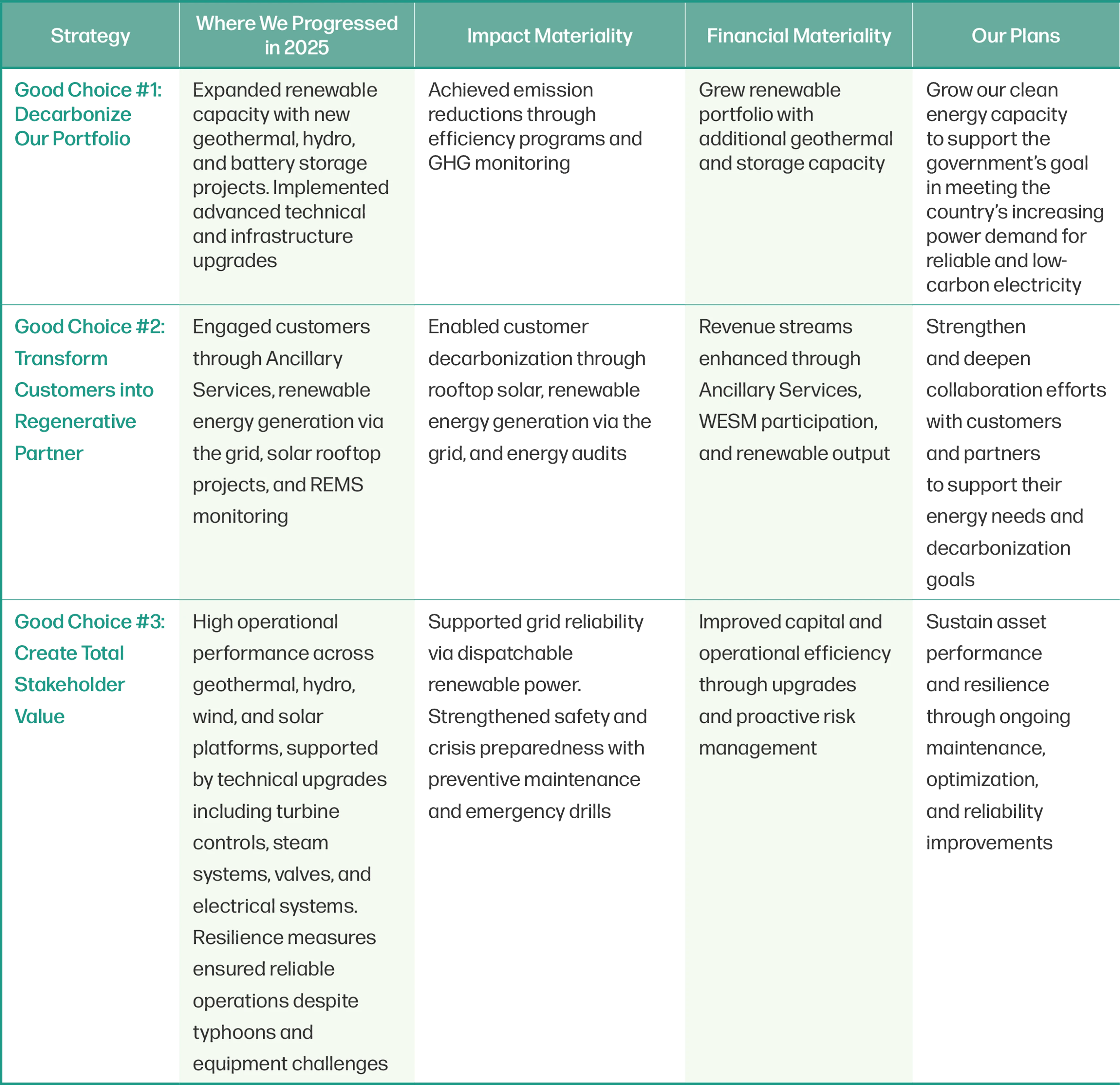
Summary of our Manufactured Capital Performance, Impacts, and Plans