

FINANCIAL CAPITAL: AT A GLANCE
Boosted Recurring Profitability.
Recurring Net Income Attributable to Equity Holders of the Parent reached USD264.5 million in 2025, a 7.9 percent increase driven by strong hydro generation and the first full year of operations of First Gen’s LNG affiliate.
Optimized Capital Structure.
The Group refinanced PHP20 billion in parent‑level debt to the operating company level to free up borrowing capacity at the Parent company.
Strong Hydro Portfolio Performance.
Pantabangan‑Masiway revenues grew 101.8 percent to PHP3.2 billion, while the Casecnan plant completed its first full year of operations under First Gen ownership.
Monetized New Storage Technology.
EDC’s 40MWh battery energy storage system projects began commercial operations in the fourth quarter and generated PHP283.9 million in net income.
Navigated Geothermal Market Headwinds.
Investments in the Drilling Operations Program drove higher costs and temporary downtime, while lower Wholesale Electricity Spot Market prices reduced merchant revenues—together contributing to a 53.5 percent decline in geothermal earnings. The diversified platform model kept First Gen’s consolidated group revenue broadly stable year-on-year at USD906.0 million.
Sustained High Tax Contributions.
The Company remitted PHP8.8 billion in taxes to national and local governments, reinforcing its role as a significant contributor to public revenues.
Financial Capital as the Backbone of Sustained Performance
First Gen’s financial capital underpins both day‑to‑day operations and long‑term growth, from funding new projects to servicing obligations to lenders and government. In 2025, this capital base supported major geothermal investments and the launch of new BESS assets.
Management Approach to Financial Capital
First Gen’s financial capital enables the reliable operation of its power plants, the development of new energy projects, and the fulfillment of obligations to lenders, government, and other stakeholders. In 2025, we focused on maintaining a stable capital structure that supports the growth of our clean energy portfolio while managing risks and funding costs at acceptable levels.
First Gen uses financial models as primary tools for planning and decision‑making. Financial modelers from different business units prepare and update these models regularly with actual results, macroeconomic assumptions, and market price forecasts. The models help assess cash generation across the Group, returns on existing and new projects against hurdle rates, capacity to service debt. They are also tested to comply with financial covenants, along with the Company’s ability to pay dividends.
Budgets, financial projections, and proposed dividends are presented to senior management and the Board for review and approval, ensuring that capital allocation decisions are aligned with the Company’s long‑term strategy and risk appetite. We also review loan agreements and funding options on a regular basis, working with internal teams and legal advisers to secure terms that match project needs and prevailing market conditions. Regular discussions with banking partners help First Gen access financing for growth projects and manage refinancing ahead of key maturities or interest rate resets.
In 2025, we placed greater emphasis on managing interest expense and refinancing parent‑level debt to the operating company level, following the full‑year consolidation of the newly acquired Casecnan hydro electric power plant and continued investments in geothermal and battery storage projects.
Financial Capital Usage and Highlights in 2025
FINANCIAL CAPITAL DISTRIBUTION
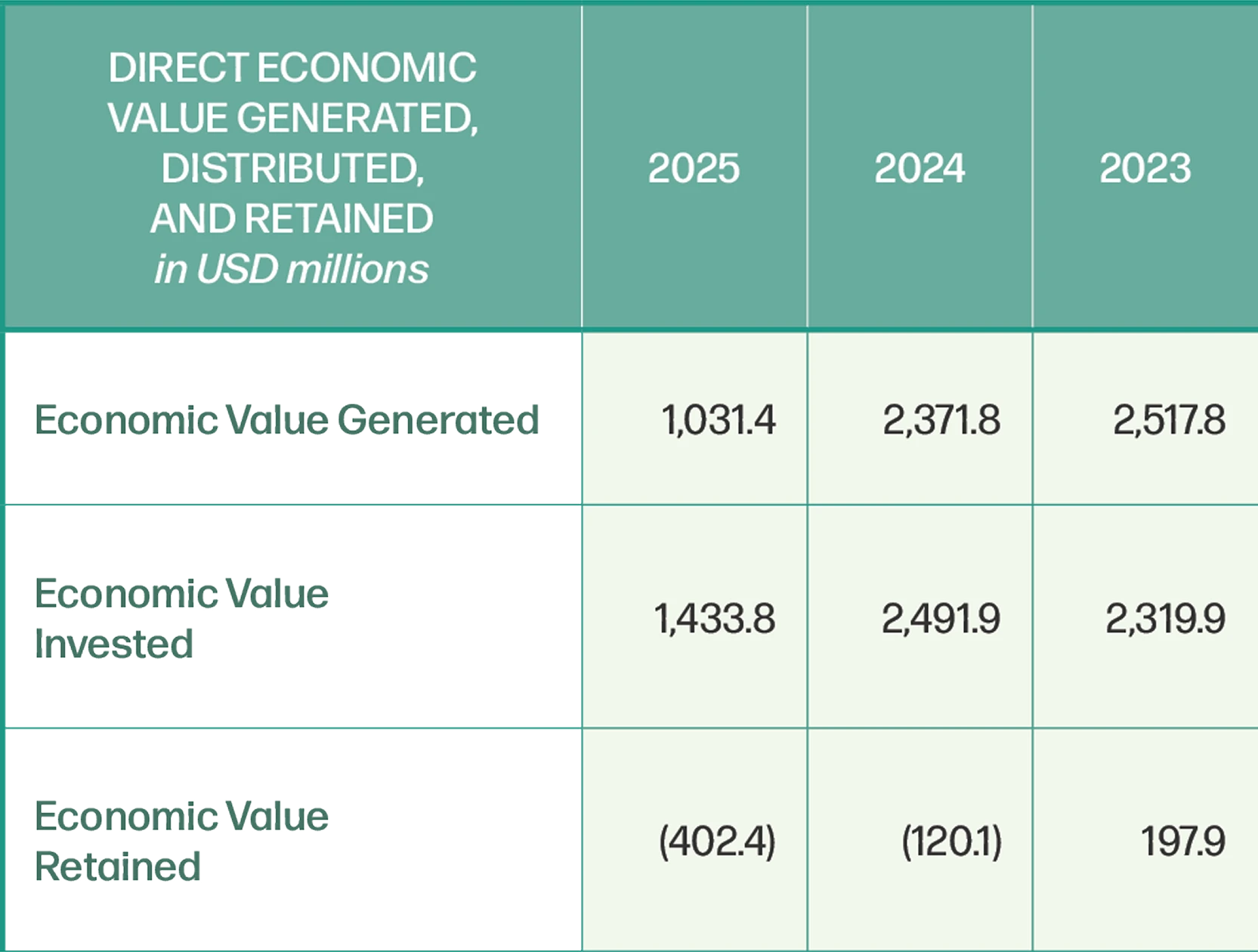
In 2025, First Gen generated an economic value of USD1,031.4 million and invested USD1,433.8 million back into the business and the wider economy. Most of the value distributed went to operating costs, employee compensation, banks and investors, taxes, and the community. Economic value retained was a deficit of USD402.4 million, compared with a deficit of USD120.1 million in 2024 and a surplus of USD197.9 million in 2023, mainly reflecting changes in earnings, capital expenditures, and scheduled debt repayments.
DISTRIBUTION OF FINANCIAL CAPITAL ACROSS CAPITALS
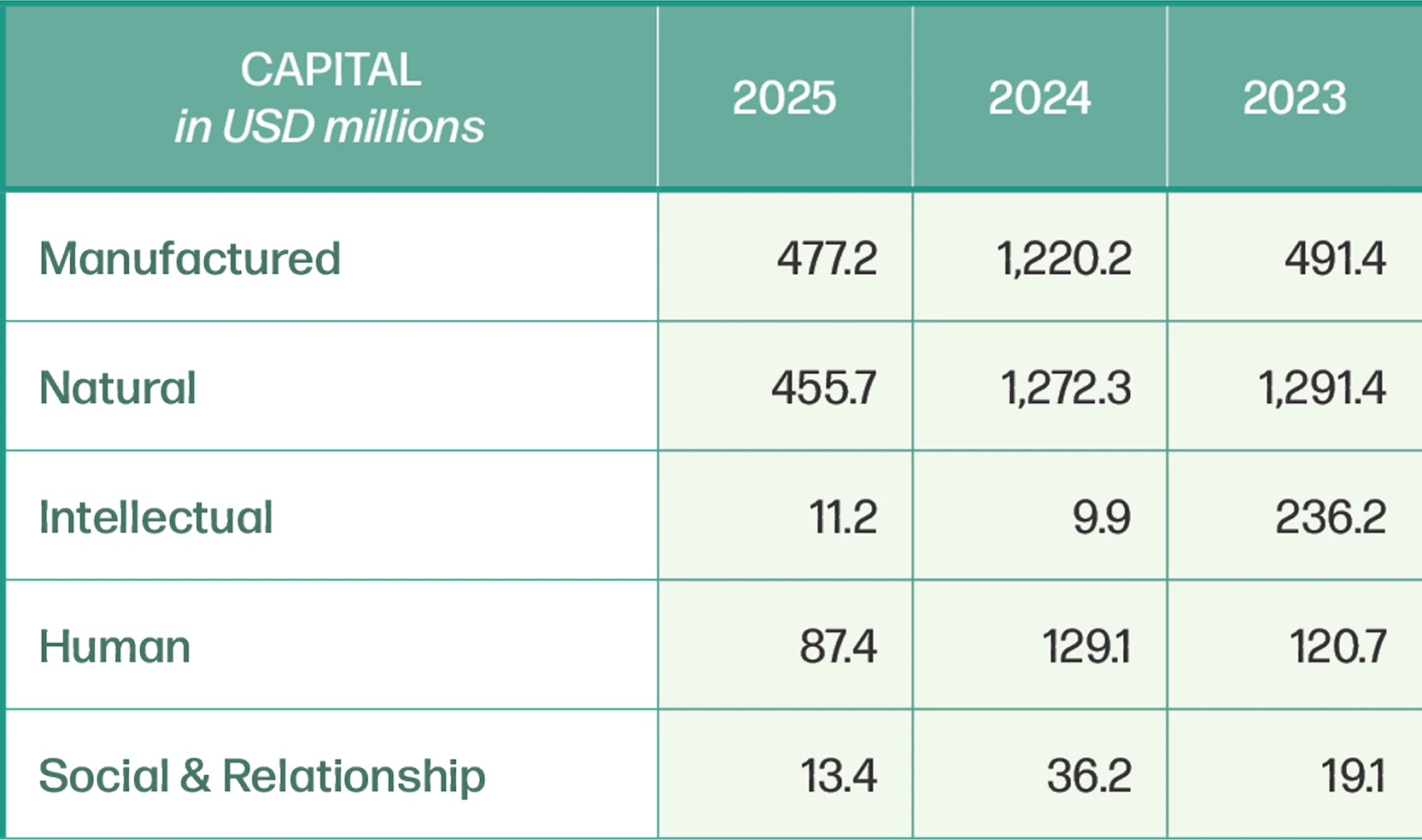
In 2025, most of First Gen’s financial capital continued to flow to Manufactured and Natural Capital, which covered project development, plant operations, equipment, fuel, and resource‑related costs. Allocations to Human Capital supported employee welfare, training, and safety programs, while Social and Relationship Capital spending focused on strengthening community initiatives. Intellectual Capital remained the smallest share of the total and was directed to IT systems, cybersecurity, and other enabling capabilities that support operations and growth. Compared with 2024, allocations continued to prioritize assets linked to hydro, LNG, and EDC, reflecting the Company’s focus on integrating newly acquired plants, ensuring fuel security, and adding flexible capacity.
Financial Discussion
FINANCIAL OUTCOMES FOR 2025 - TOTAL GROUP
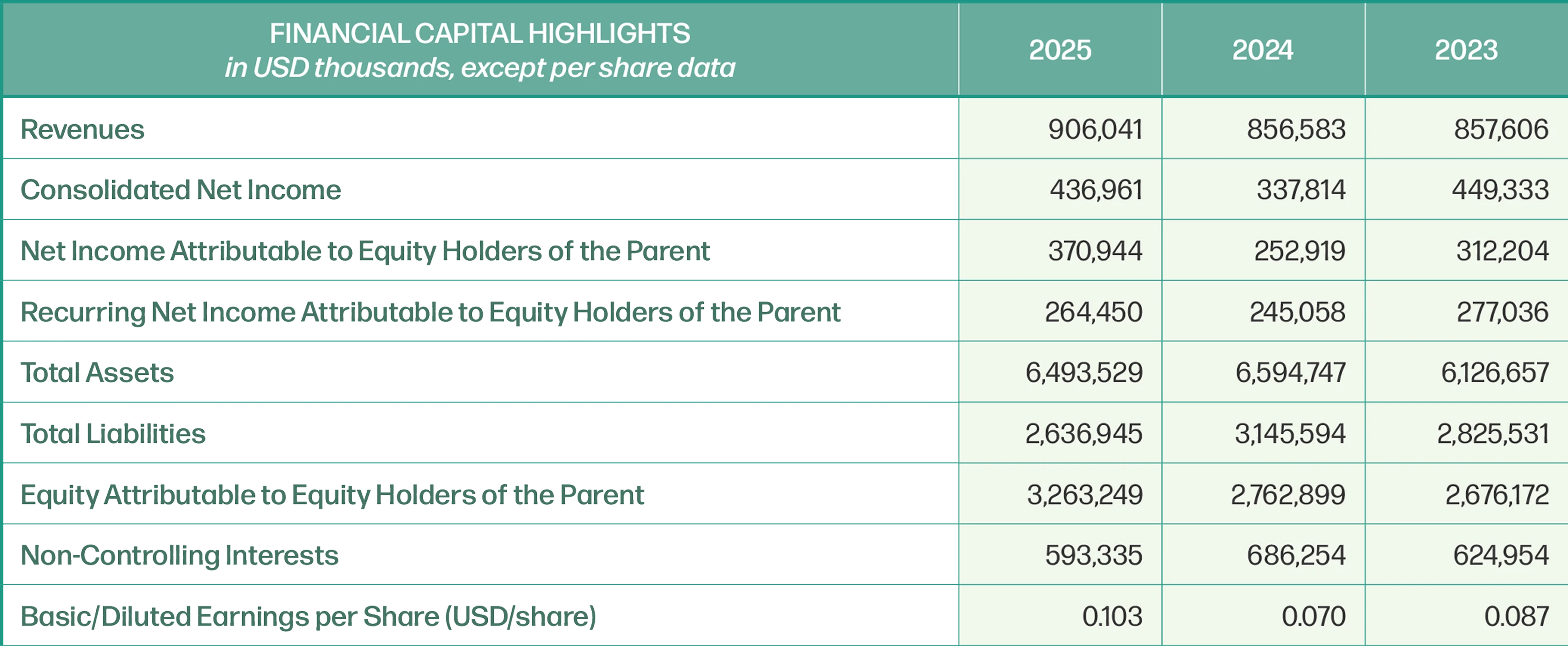
First Gen recorded revenues of USD906.0 million in 2025, higher than in 2024. Consolidated Net Income reached USD437.0 million, while Recurring Net Income Attributable to Equity Holders of the Parent rose by 7.9 percent to USD264.5 million. Total assets stood at USD6.5billion, with total liabilities at USD2.6 billion and equity attributable to equity holders of the parent at USD3.3 billion. Basic earnings per share for the year increased to USD0.103 from USD0.070 in 2024.
Recurring earnings growth was led primarily by the hydro platform and the natural gas affiliate and was partly offset by weaker results from the geothermal platform. Hydro benefited from higher generation and improved contract structures, while the natural gas affiliate saw a full year of contributions from the LNG Interim Offshore Terminal and lower interest expense. Geothermal earnings declined due to higher operating costs from its drilling and growth programs, higher interest costs on borrowings, and lower WESM prices.
Financial Performance by Platform
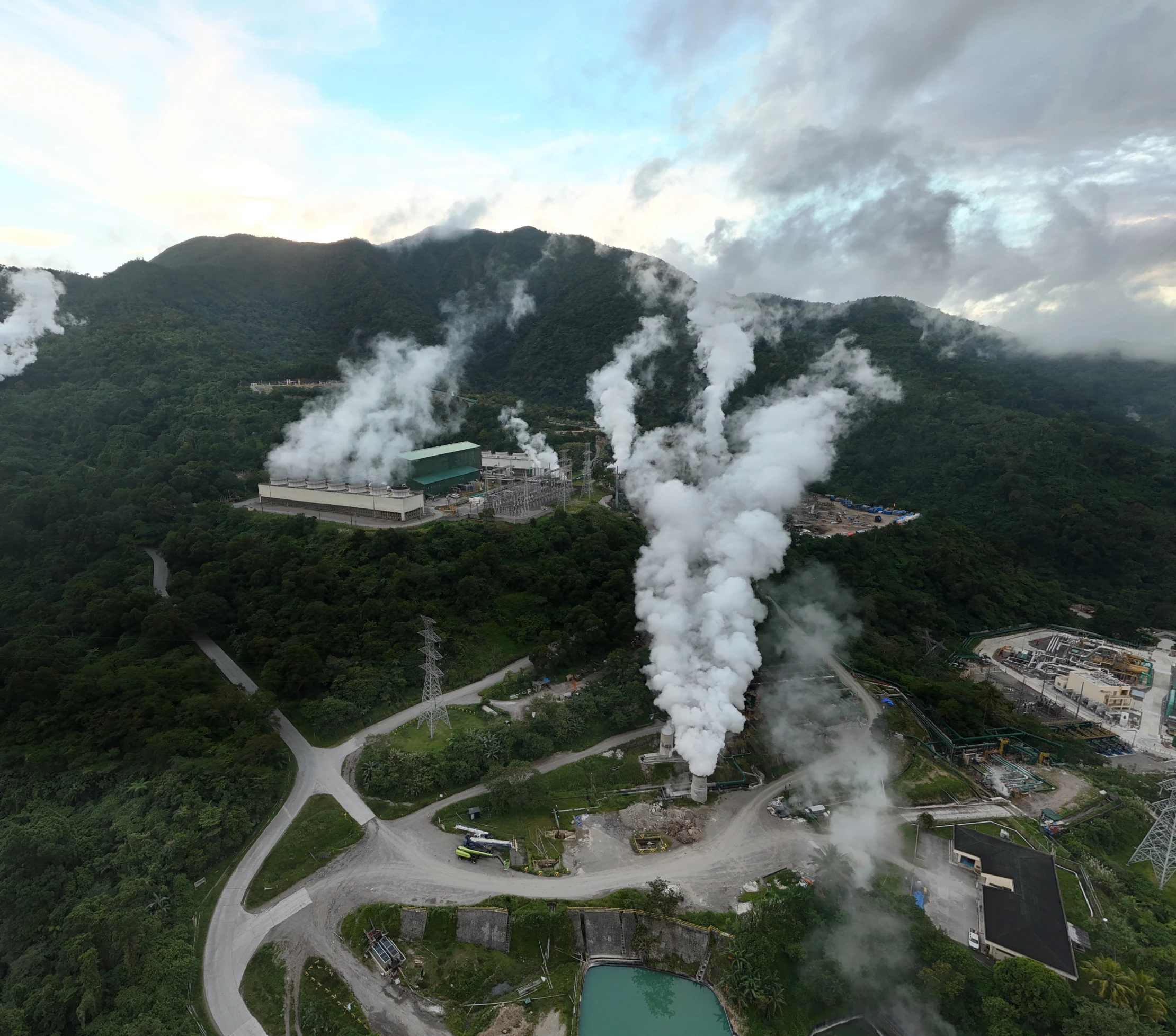
GEOTHERMAL BUSINESS UNIT
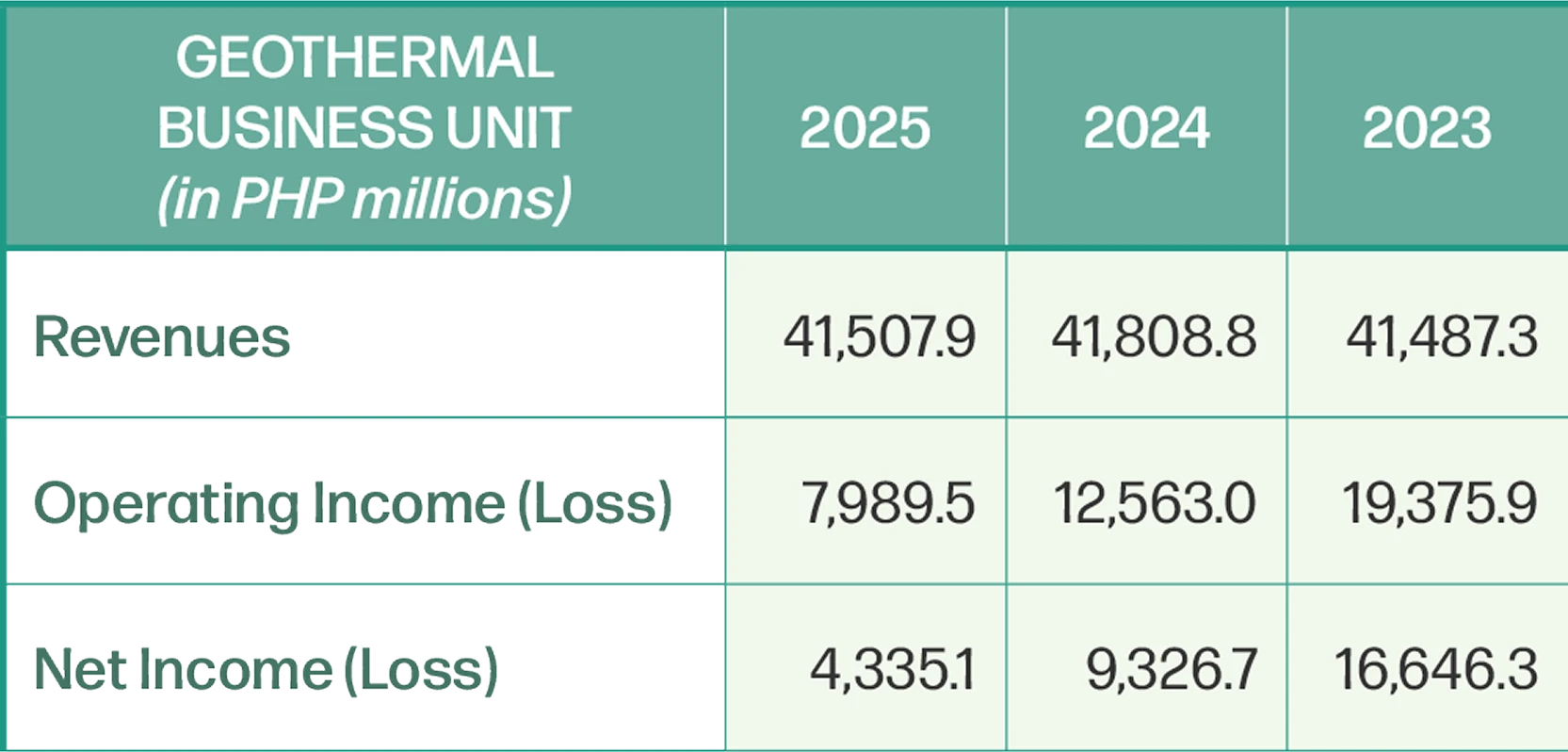
The geothermal platform reported a net income of PHP4.3 billion in 2025, a 53.5 percent decline from PHP9.3 billion in 2024. The decrease was mainly due to lower WESM prices, which reduced revenues from merchant sales, and higher operating costs related to steam field maintenance and workover activities. Higher interest expense on borrowings also weighed on earnings.
HYDRO BUSINESS UNIT
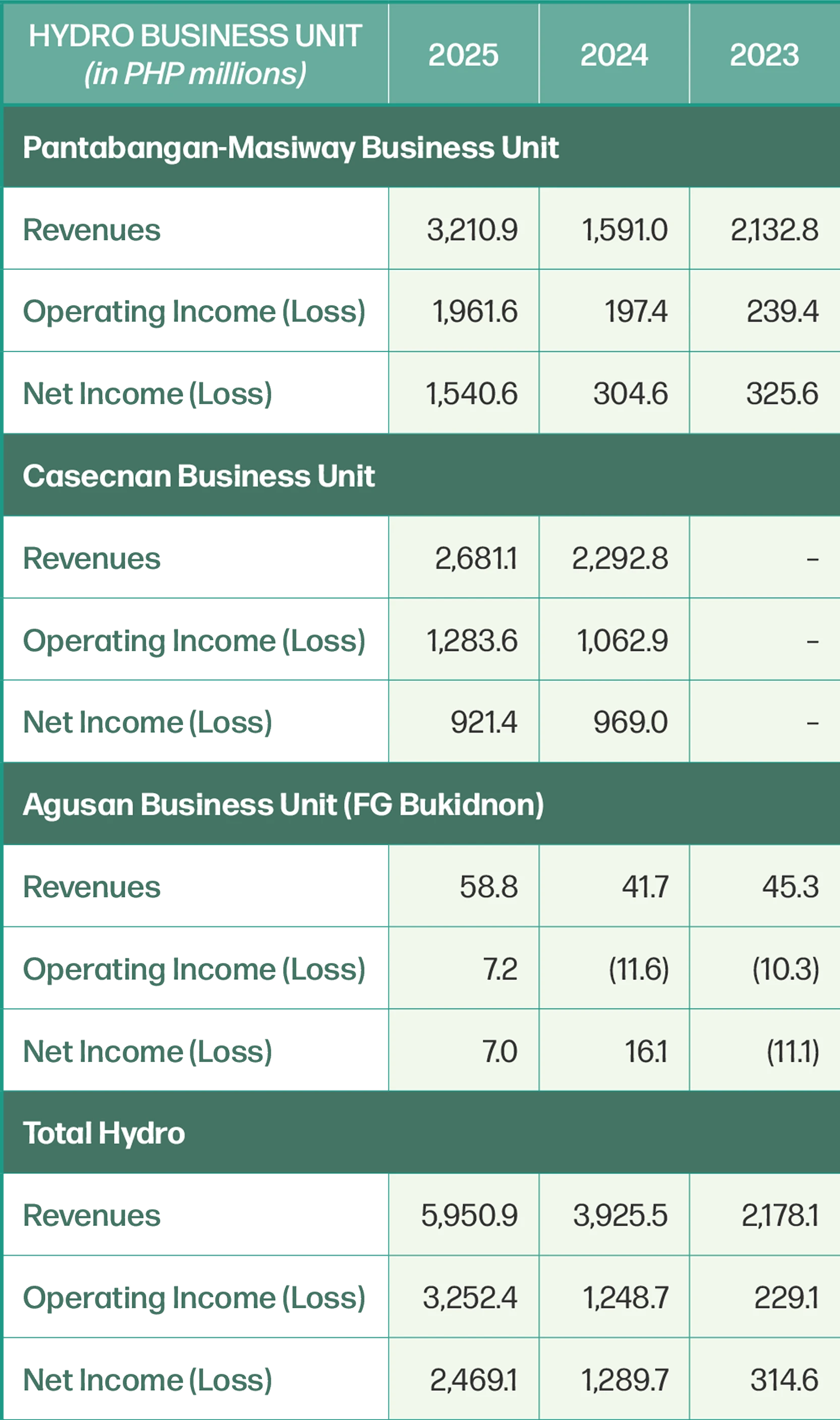
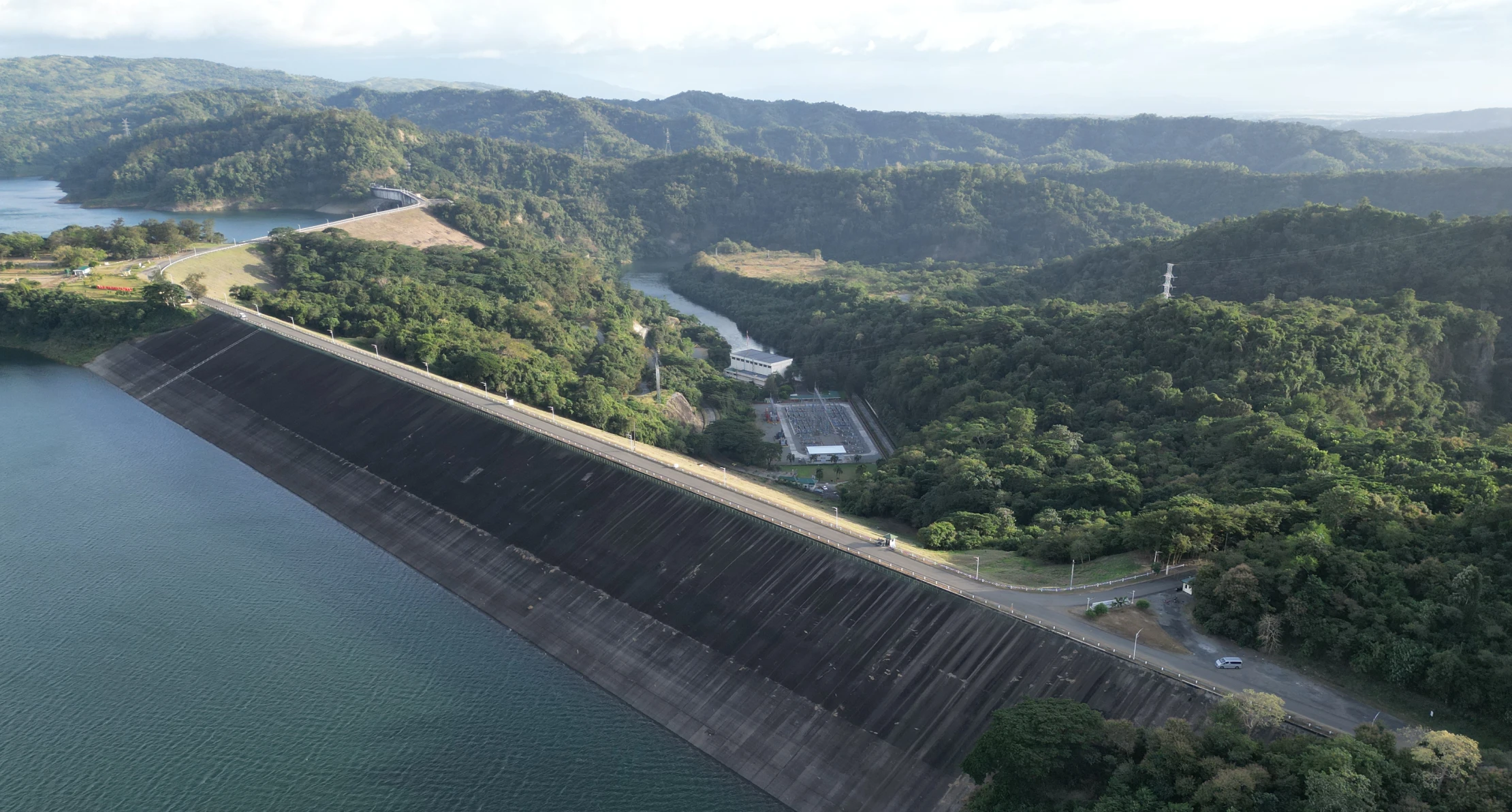
Combined, the hydro portfolio generated PHP6.0 billion in revenues and PHP2.5 billion in net income in 2025, reflecting the full year operation of Casecnan and stronger generation at Pantabangan‑Masiway.
Pantabangan‑Masiway’s revenues doubled to PHP3.2 billion in 2025 from PHP1.6 billion in 2024, supported by higher generation from improved reservoir water levels and increased irrigation diversion requirements by the National Irrigation Administration (NIA) with this year’s three cropping seasons. Operating income improved as higher sales coincided with lower replacement power costs, although these gains were partly offset by higher interest expense following the draw of a PHP7 billion term loan. Net income rose to PHP1.5 billion, a 405.8 percent increase year‑on‑year.
The Casecnan Hydroelectric Power Plant recorded a 16.9 percent increase in revenues following its first full year of operations under First Gen in 2025. This resulted in higher operating income, though higher interest costs from a PHP15-billion term loan led to a slight 4.9 percent decline in net income to PHP921.4 million.
FG Bukidnon’s revenues grew by 40.9 percent to PHP58.8 million in 2025, driven by favorable water inflows and an improved contract price under its new power supply agreement with Minergy RES. Net income, however, fell by 56.7 percent to PHP7.0 million as due to the recognition of other income in the previous year.
WIND, SOLAR, AND BESS
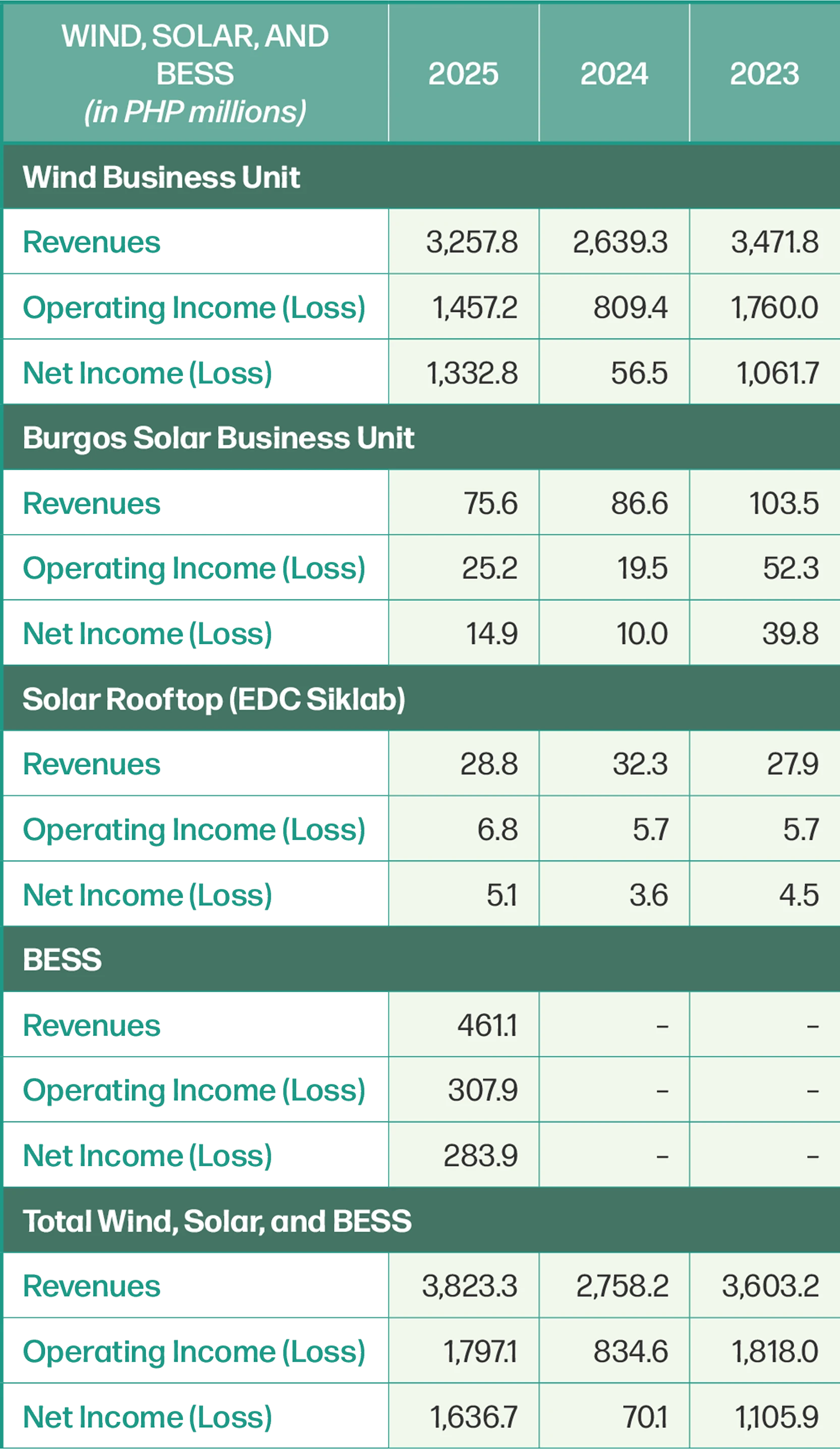
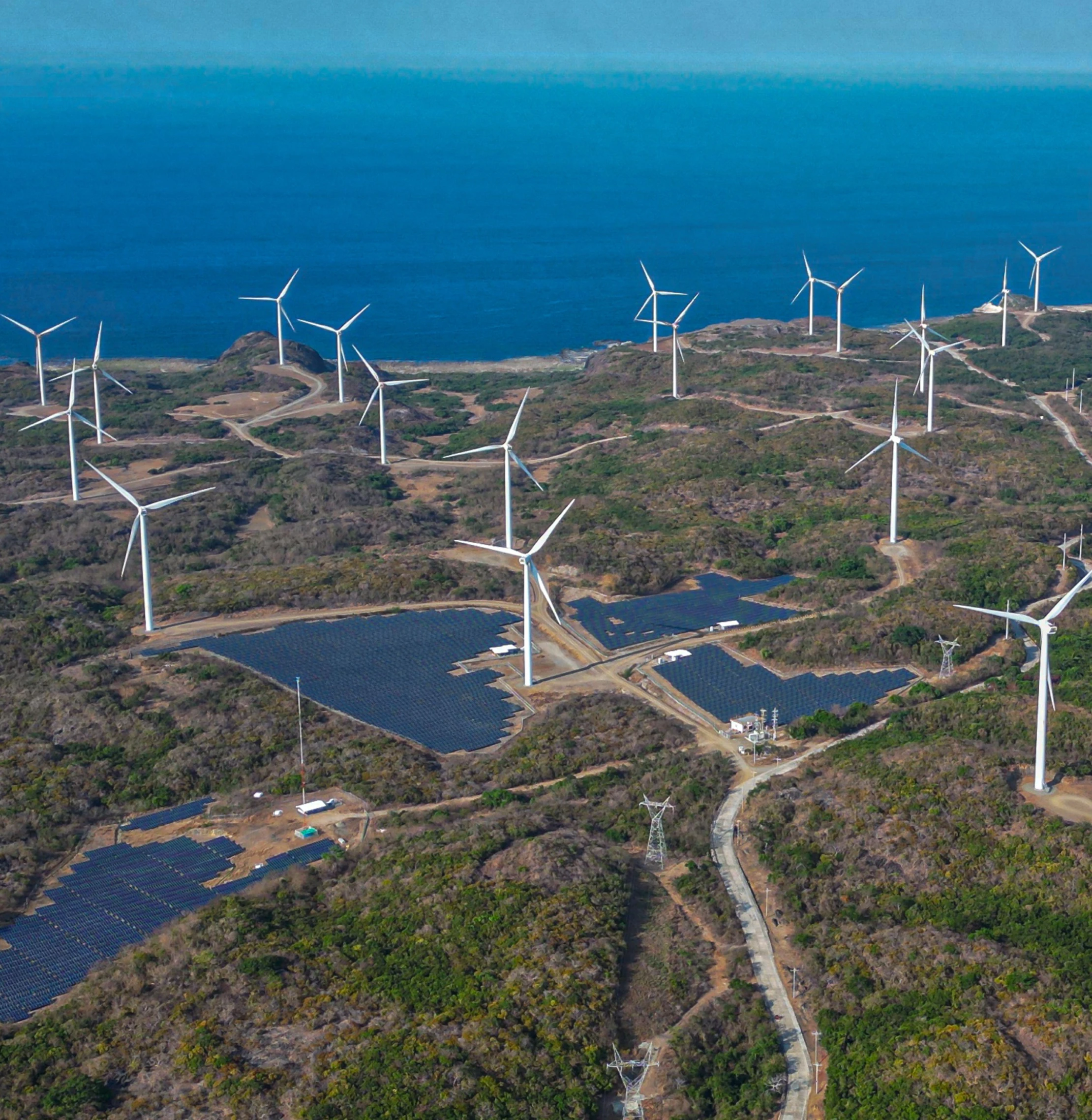
Taken together, the wind, solar, and BESS portfolio delivered PHP3.8 billion in revenues and PHP1.6 billion in net income in 2025, underscoring the growing role of flexible and variable renewables in the Group’s earnings mix.
Burgos Wind’s net income increased sharply to PHP1.3 billion in 2025 from PHP56.5 million in 2024, mainly due to FIT adjustments recorded in 2025 that related to generation from 2021 to 2025. Burgos Solar’s net income rose by 48.8 percent to PHP14.9 million, driven primarily by lower operating expenses for plant operations and maintenance. EDC Siklab’s net income grew by 41.2 percent to PHP5.1 million in 2025 from PHP3.6 million in 2024, reflecting lower spending on contracted services and income taxes. EDC’s 40MWh battery energy storage system projects began commercial operations in the fourth quarter of 2025 and generated a net income of PHP283.9 million during the year.

Tax Strategy and Governance
First Gen remains committed to strong tax compliance and governance. The Company supports government tax programs and reforms and recognizes that its tax payments form an important contribution to national and local development.
The Tax Team within the Accounting Group oversees tax planning, compliance, audit management, and advocacy, with senior management and the Board providing oversight of major tax‑related decisions. Tax processes are integrated into the Group’s financial and accounting systems, using automation and data analytics to monitor obligations, support accurate reporting, and keep pace with changes in regulations. First Gen also works with external practitioners and industry associations to stay aligned with evolving tax rules and leading practices.
In 2025, First Gen and its non‑gas subsidiaries contributed approximately PHP8.8 billion in taxes to the government, consisting of PHP7.9 billion in national taxes, PHP0.7 billion in local taxes, and PHP0.3 billion in government share and Energy Regulations No. 1‑94 (ER 1‑94) remittances.
Summary of Our Financial Capital Performance, Impacts, and Plans
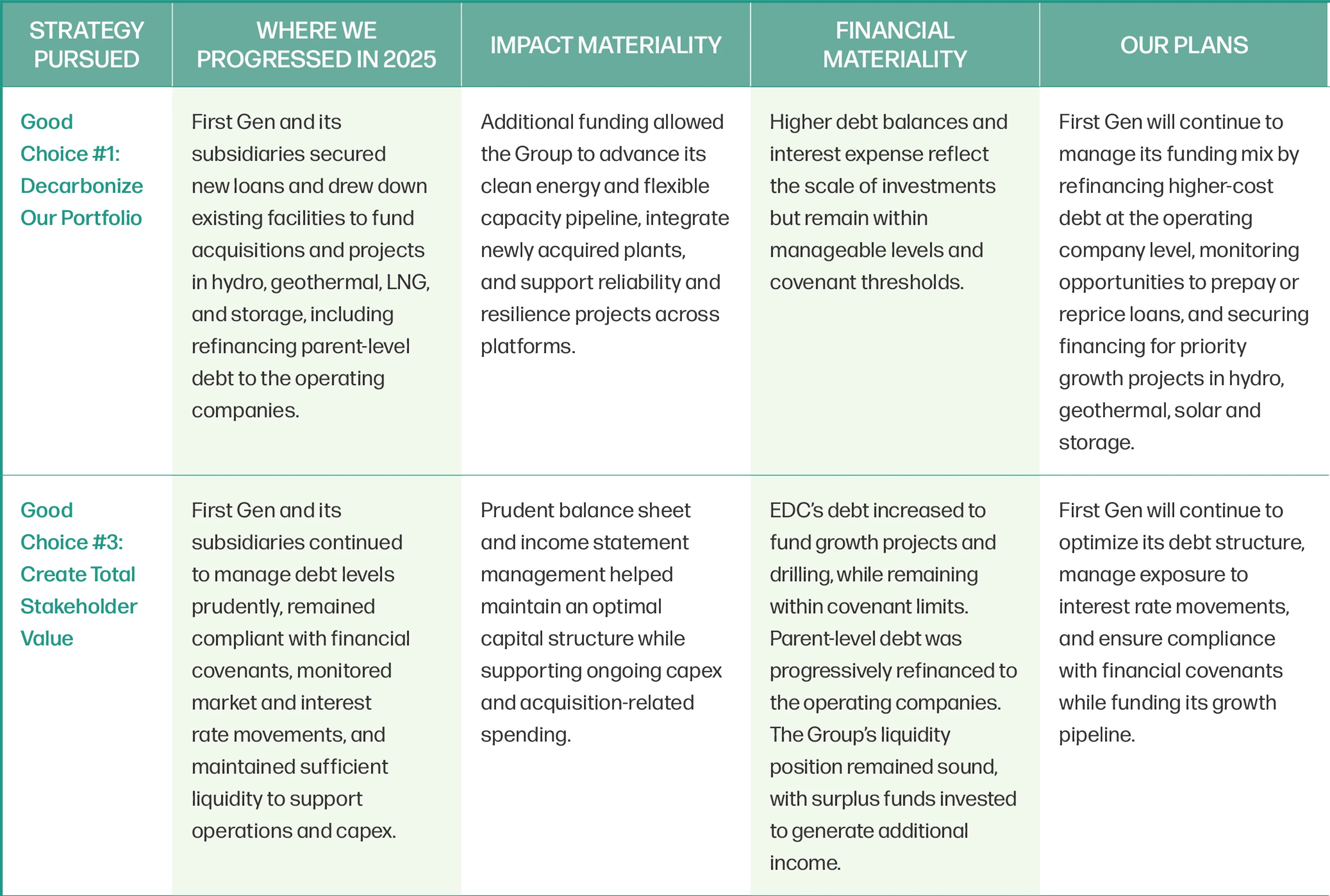
To know more about how Financial Capital contributes to First Gen’s effort to forge collaborative pathways for a decarbonized and regenerative future, see Financial Capital section.
Details on how Financial Capital is allocated across other capitals can be found in the ESG Values section.